Stroke Care
Contact Us
Dedicated to the prevention, diagnosis and treatment of stroke
Our multidisciplinary stroke team includes emergency medicine physicians, neurologists, neurosurgeons, neuroradiologists, neuropsychologists and rehabilitation specialists.
Trinity Health Of New England provides stroke care dedicated to treating patients with transient ischemic attack (TIA), ischemic and hemorrhagic strokes as well as other entities like vasculitis, arterial dissections, and cerebral venous thromboses. For acute ischemic stroke patients, our facility offers Thrombolytic Therapy with a medication called tPa, a “clot buster” indicated for dissolving intracranial blood clots. Alternatively, we offer a procedure called, Mechanical Thrombectomy, which allows for the removal of a blood clot from the brain using small arterial catheters that are inserted into the groin and are meticulously maneuvered upwards toward the brain.
Aside from ischemic stroke management, our 24/7 Neurointerventional team also focuses on diagnosing and treating patients with complex vascular neurologic disorders such as vasculitis, moya moya disease, cerebral aneurysms, carotid stenosis, cerebral venous thrombosis, and vascular malformations. We offer procedures such as diagnostic angiography, thrombectomy for acute stroke, aneurysm coiling, arterial embolization for epistaxis and arteriovenous malformations, carotid artery stenting, and pre-operative embolization of brain tumors.
The Stroke Program at Trinity Health Of New England collaborates with many specialized teams consisting of neurology providers, trained nurses, and inpatient rehabilitation teams including Physical Therapists, Occupational Therapists, and Speech Pathologists, to provide comprehensive stroke care. After hospitalization, our stroke patients receive outpatient rehab services or are transferred to our affiliated rehabilitation facility, Mount Sinai Rehabilitation Hospital, for ongoing care.
In order to promote continuity of care, all of our patients receive a follow-up appointment, where we manage post stroke symptoms and provide stroke prevention education. We are also able to perform further evaluations for patients with stroke of undetermined cause.
As part of Trinity Health Of New England, Saint Francis Hospital provides 24-hour stroke care dedicated to treating patients with transient ischemic attack (TIA), ischemic and hemorrhagic strokes as well as other entities like vasculitis, arterial dissections, and cerebral venous thromboses. For acute ischemic stroke patients, our facility offers Thrombolytic Therapy with a medication called tPa, a “clot buster” indicated for dissolving intracranial blood clots. Alternatively, we offer a procedure called, Mechanical Thrombectomy, which allows for the removal of a blood clot from the brain using small arterial catheters that are inserted into the groin and are meticulously maneuvered upwards toward the brain.
Aside from ischemic stroke management, our 24/7 Neurointerventional team also focuses on diagnosing and treating patients with complex vascular neurologic disorders such as vasculitis, moya moya disease, cerebral aneurysms, carotid stenosis, cerebral venous thrombosis, and vascular malformations. We offer procedures such as diagnostic angiography, thrombectomy for acute stroke, aneurysm coiling, arterial embolization for epistaxis and arteriovenous malformations, carotid artery stenting, and pre-operative embolization of brain tumors.
Aside from ischemic stroke management, our 24/7 Neurointerventional team also focuses on diagnosing and treating patients with complex vascular neurologic disorders such as vasculitis, moya moya disease, cerebral aneurysms, carotid stenosis, cerebral venous thrombosis, and vascular malformations. We offer procedures such as diagnostic angiography, thrombectomy for acute stroke, aneurysm coiling, arterial embolization for epistaxis and arteriovenous malformations, carotid artery stenting, and pre-operative embolization of brain tumors.
The Stroke Program at Saint Francis Hospital and its affiliates collaborates with many specialized teams consisting of neurology providers, trained nurses, and inpatient rehabilitation teams including Physical Therapists, Occupational Therapists, and Speech Pathologists, to provide comprehensive stroke care. After hospitalization, our stroke patients receive outpatient rehab services or are transferred to our affiliated rehabilitation facility, Mount Sinai Rehabilitation Hospital, for ongoing care.
In order to promote continuity of care, all of our patients receive a follow-up appointment, where we manage post stroke symptoms and provide stroke prevention education. We are also able to perform further evaluations for patients with stroke of undetermined cause.
Resources
- American Heart Association
- American Stroke Association
- Effects of Stroke (American Stroke Association)
- Global Neurosciences Institute Support Groups
- Know the Signs of a Stroke (Video)
- Let's Talk About Stroke Fact Sheets (American Stroke Association)
- Mobility and Exercise After Stroke (Stroke Foundation)
- Recovery Tips for Daily Living (American Stroke Association)
- Saint Francis Hospital Advanced Stroke Center Outcomes
- Simply Good - A cookbook for stroke survivors and their families (American Stroke Association)
- Stroke Awareness Month: What are the symptoms to look out for? (FOX61 Interview with Dr. Dimitre Mirtchev)
- Stroke Education Booklet
- Stroke Education Booklet (Español)
- Stroke Support Groups (English)
- Stroke Support Groups (Español)
- Stroke Virtual Support Group
Outcomes
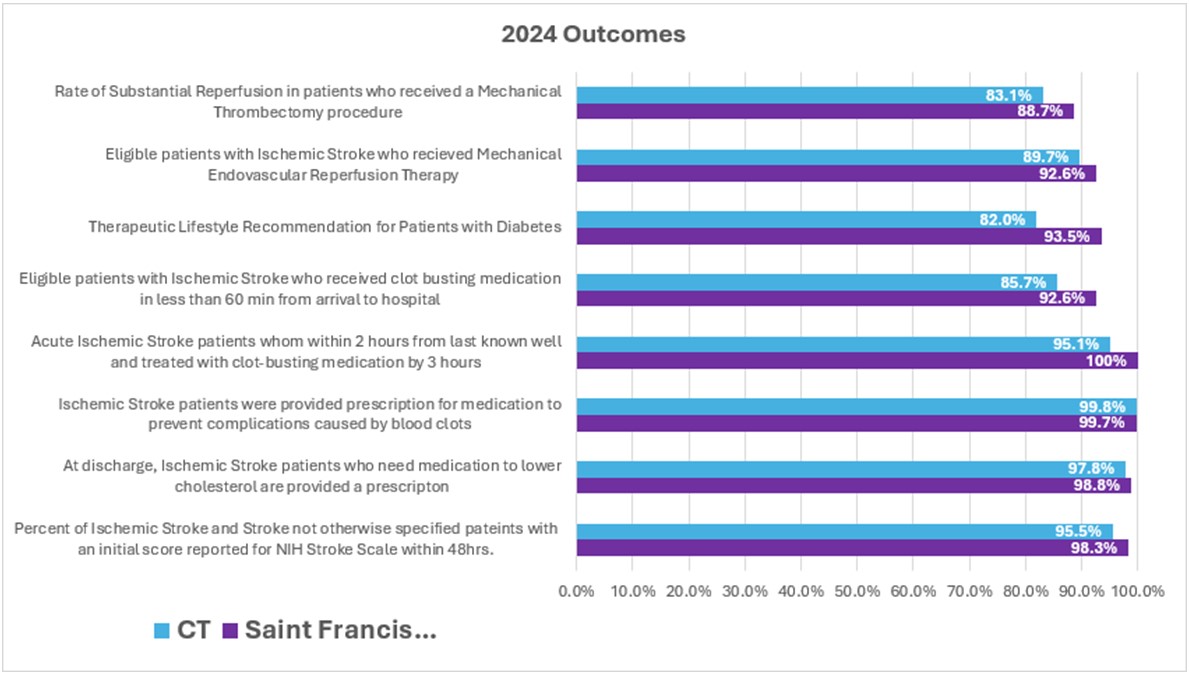
At Saint Francis Hospital we are dedicated to highest standards and best outcomes for our stroke patients, while upholding compassion, empathy and individualized care. We participate in multiple quality improvement initiatives and utilize patient registries to closely evaluate and evolve our stroke program. We perform at or above Connecticut and national levels on all major patient-related performance metrics.
Saint Francis Hospital contributes to the Vascular Quality Initiative, a nationwide prospective database used to collect and analyze outcomes of surgical and minimally invasive vascular procedures.
Saint Francis Hospital contributes to the Vascular Quality Initiative, a nationwide prospective database used to collect and analyze outcomes of surgical and minimally invasive vascular procedures.
- Carotid Artery Stenting (CAS) and Carotid Endarterectomy (CEA) Outcomes (January 1 – December 31, 2024)
- CAS post op stroke /all death rate = 0% (National trend stroke/death rate = 4.0%)
- CEA post op stroke / all death rate = 0% (National trend stroke/death rate = 3.0%)
Additional public reported data can be found on the American Heart Association’s public reporting website: Hospital Reporting (heart.org)
Saint Francis Hospital Advanced Stroke Center monitors all stroke patient outcomes to provide highest quality of stroke care.